Korea’s Massive AI Investment Plan and the Next Wave of Memory Industry Competition
Keywords: Korea AI investment, Samsung Electronics, SK hynix, memory chips, DRAM, HBM, AI data centers, semiconductor expansion, market competition, supply chain
Introduction
South Korea’s announcement of a massive AI-driven investment program on June 29 immediately drew global attention. Yet the market reaction to two of the plan’s most prominent participants—Samsung Electronics and SK hynix—was unexpectedly cautious. On the same day, Samsung’s share price fell 4.86% and SK hynix declined 1.68%, while both stocks remained volatile during intraday trading on June 30.
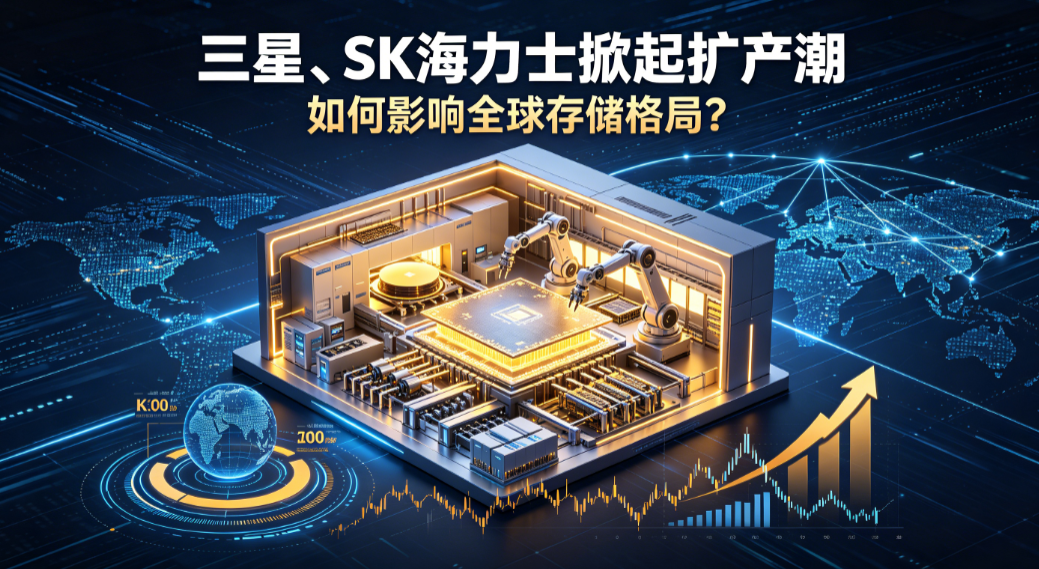
This divergence between policy enthusiasm and capital market skepticism highlights a key question: will the new round of investment truly strengthen Korea’s semiconductor leadership, or will it intensify competition in an already tight memory market? More specifically, what impact will this expansion have on the global memory industry, especially on DRAM and HBM, two segments that are now tightly linked to AI demand?
A New Round of Capacity Competition Begins
The Korean government, together with Samsung and SK Group, announced a combined domestic investment plan worth 4,755 trillion won, focused on three strategic pillars: semiconductors, physical AI, and AI data centers. As part of the broader initiative, South Korea’s southwestern region will see 800 trillion won invested in four semiconductor fabs, with Samsung Electronics and SK hynix each expected to build two facilities.
At the corporate level, SK hynix plans to invest 1,100 trillion won to expand DRAM and NAND flash supply. Samsung, meanwhile, will build a new wafer fabrication facility in Gwangju with an investment of 400 trillion won, and Samsung Electronics will also establish new HBM facilities in Cheonan and Wontong with an additional 56 trillion won.
These announcements signal the start of a new capacity race. In the memory industry, where supply and pricing are highly cyclical, expansion decisions often reshape competitive dynamics over time. However, the key issue is not merely how much capacity is added, but what kind of capacity is added and how quickly it reaches the market.
According to Counterpoint, in the first quarter of this year Samsung Electronics, SK hynix, Micron and ChangXin Memory Technologies accounted for 38%, 29%, 22% and 8% of the global DRAM market, respectively. In NAND flash, Samsung, SK hynix, Micron, Kioxia, SanDisk and Yangtze Memory held 29%, 18%, 13%, 14%, 13% and 13% of the market.
This means Korea’s two memory giants already dominate a highly concentrated market. Their main rivals in DRAM are Micron and China’s ChangXin; in NAND, they face competition from Micron, SanDisk, Kioxia and Yangtze Memory. The latest Korean expansion plans may further reinforce this structure, but only if competitors do not respond with their own aggressive investments.
Why the Market Remains Cautious
Despite the scale of the announcement, investors did not respond with enthusiasm. One reason is timing. Memory capacity expansion is not immediate; from capital expenditure to mass production, the cycle often takes several years. Many industry observers expect new supply to enter the market only around 2027, or even later.
TrendForce analyst Xu Jiayuan said new fabs are likely to begin production between the second half of 2027 and 2028, suggesting that DRAM shortage conditions are unlikely to ease in the near term. In other words, the industry’s current supply-demand imbalance will probably continue for some time.
At the same time, the Korean announcement may accelerate a broader industry response. AI demand remains strong, and every major supplier is now under pressure to expand. Micron has already indicated that capital expenditures in fiscal 2026 will be around $27 billion, with quarterly spending above $1 billion in fiscal 2027. ChangXin, meanwhile, plans to raise 29.5 billion yuan through an IPO to fund DRAM technology upgrades and wafer manufacturing line improvements.
This suggests that the competitive landscape is still in flux. The eventual market share distribution will depend less on who announces the biggest investment and more on who executes fastest, secures customers, and successfully converts capacity into revenue.
The Real Target: Server DRAM and HBM
The most important aspect of Korea’s new investment plan is not general memory capacity, but the pursuit of high-margin AI-related products—especially server DRAM and HBM.
Xu Jiayuan noted that Samsung Electronics and SK hynix’s expansion strategy for 2026 to 2030 is designed primarily to win long-term orders from large cloud service providers and thereby increase market share in premium server DRAM and HBM products. These segments are the most closely tied to AI infrastructure and offer stronger profitability than conventional memory products.
Server DRAM and HBM are also the areas where technical barriers are highest. Reliability requirements for server use are stringent, and AI workloads demand large bandwidth, high performance and stable operation. That makes product qualification and customer relationships especially critical.
In HBM, the competition is even faster-moving. Unlike traditional DRAM products, which may have lifecycles of around a decade, HBM cycles can be as short as five years. According to Counterpoint, in the first quarter SK hynix held 58% of the HBM market, while Samsung and Micron each held 21%. SK hynix’s share has declined from 69% in the first quarter of last year, while Samsung and Micron have been closing the gap.
The technology race is also accelerating. The three major overseas players have already moved from HBM3 to HBM4E. Samsung and SK hynix reportedly delivered HBM4E samples to key customers in May and June, respectively, while Micron expects mass production of HBM4E in 2027. All three companies have also been integrated into Nvidia’s supply chain this year.
For Chinese memory makers, however, the situation is more challenging. ChangXin has not yet announced mass production of HBM, and it remains a later entrant in this fast-evolving segment. This means that while Korean expansion does not directly target Chinese firms in the short term, it raises the competitive bar across the entire industry.
Could Expansion Lead to Oversupply?
The bigger strategic question is whether AI-driven memory expansion could eventually create another oversupply cycle. The memory industry has a long history of boom-and-bust dynamics, and previous cycles have left manufacturers cautious about aggressive capital spending.
Before this latest Korean announcement, some industry insiders described manufacturers as relatively conservative because they still remember the impact of earlier periods of oversupply. Yet sentiment may now be changing. Samsung and SK hynix are accelerating investment, and Micron management has also recently said that while supply conditions are improving, demand should remain strong because AI is still in its early stages.
This is a reasonable argument, but it does not eliminate risk. If every major supplier expands simultaneously, and if AI demand growth slows or becomes more concentrated among a few customers, the market could once again face pricing pressure. The difference this time is that expansion is being driven not by speculative consumer demand, but by structural demand from cloud computing, AI training and data center deployment. That makes oversupply less likely in the near term, but not impossible in the medium term.
Conclusion
South Korea’s latest AI investment plan is more than a domestic industrial policy announcement. It is a strategic move aimed at securing the future of the global memory industry. Samsung Electronics and SK hynix are clearly positioning themselves to capture the most valuable part of the AI memory market—server DRAM and HBM—while defending their leadership against Micron and potential challengers from China.
Still, the market’s muted reaction suggests that investors are focused on execution rather than headlines. The memory industry is entering a new phase of competition, but the impact of this expansion will only become clear over the next several years, as new fabs come online, customer orders are allocated and supply conditions evolve.
For now, one conclusion stands out: AI is not only reshaping computing architecture, but also redefining the global memory hierarchy. The companies that can expand capacity, deliver advanced products and secure stable customer relationships will be best positioned to benefit from the next wave of semiconductor growth.