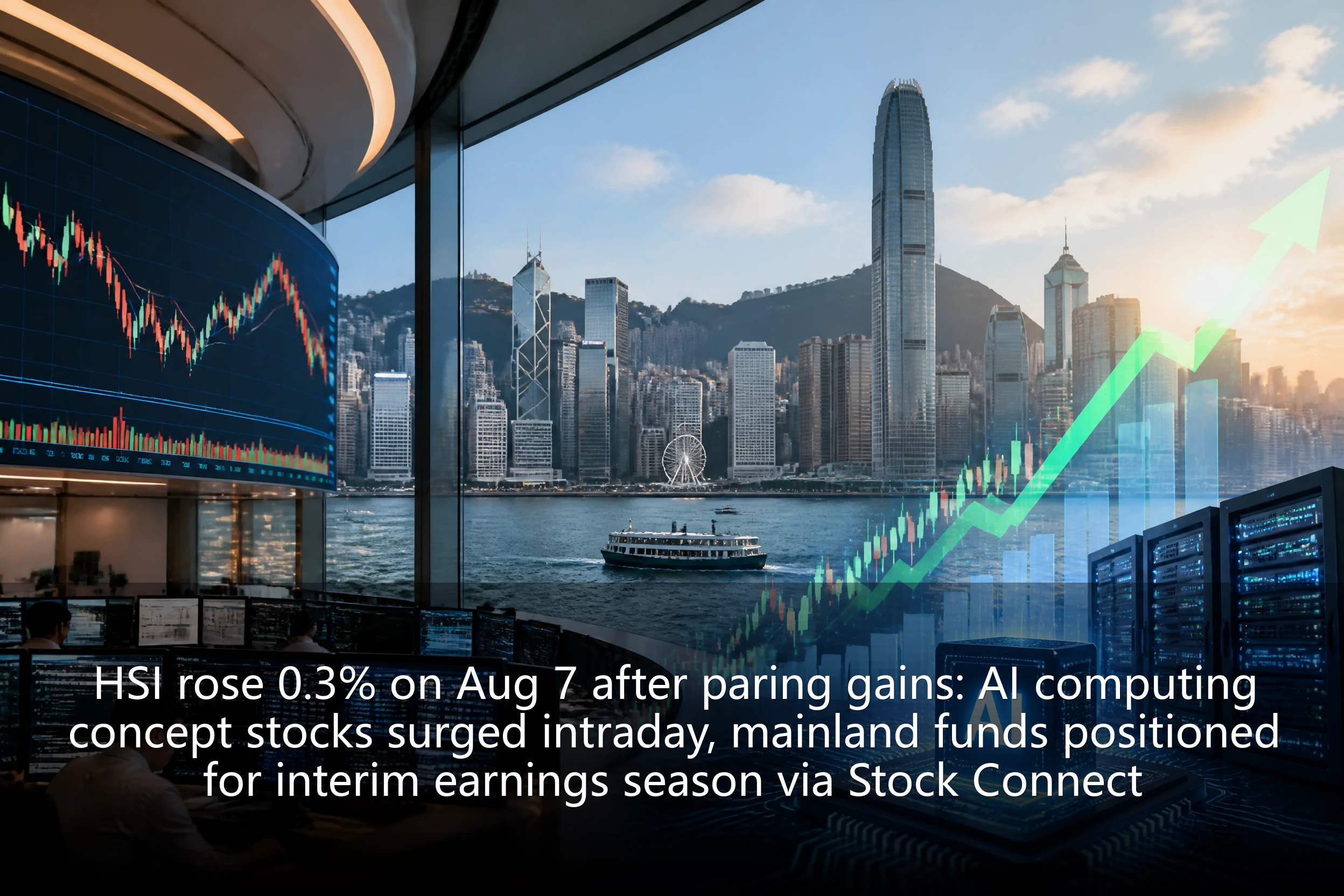
HSI rose 0.3% on Aug 7 after paring gains: AI computing concept stocks surged intraday, mainland funds positioned for interim earnings season via Stock Connect
On August 7, 2026, after consecutive rebounds, the Hong Kong stock market showed a trend of paring early gains and consolidating in a narrow range. The Hang Seng Index opened higher and tested resistance, but under profit-taking pressure from heavyweights, gains narrowed significantly in the afternoon, closing up just 0.3%. The market showed clear divergence. Boosted by an overnight rebound in US tech stocks and the continuous expansion of the global AI industry chain, AI computing concept stocks surged intraday, becoming the most striking highlight. Meanwhile, traditional heavyweight internet platforms and financial shares were relatively weak, dragging down the index.
Notably, as the August interim earnings disclosure season enters its intensive phase, southbound funds are quietly adjusting positions via Stock Connect. Today's mainland capital flows clearly show a 'positioning for the earnings season' characteristic, with computing infrastructure sectors with positive earnings expectations and defensive high-dividend assets becoming safe havens for capital. Against a complex global macroeconomic backdrop and uncertainty over the Fed's policy path, the HK market is seeking new valuation anchors through structural adjustments.
Market Review: Early gains met resistance, long-short game intensifies
Today's HSI trend reflects the hesitation and game between bulls and bears near key levels. In the morning, boosted by improved external sentiment and favorable macro data, the HSI opened over 1% higher, approaching previous highs. However, as the index reached areas with heavy trapped selling pressure, selling pressure increased significantly. In the afternoon, as short-term funds took profits, gains narrowed continuously, closing up just 0.3%.
From a technical analysis perspective, this pullback indicates that overhead resistance remains strong. After July's sustained rebound, HK stocks have accumulated profit-taking pressure, needing consolidation to digest these chips in the short term. Regarding volume, today's total turnover shrank from the previous day, indicating insufficient willingness to chase highs at current levels, while existing funds prefer sector rotation and structural adjustments. This shrinking volume consolidation is expected to continue until a new strong catalyst emerges to break the balance.
Market Anomalies: AI computing concept stocks buck the trend, funds bet on earnings beats
Behind the flat index, individual stock movements were exciting. AI computing concept stocks were undoubtedly the most eye-catching focus. Influenced by accelerated global AI model iterations, surging computing demand, and overnight gains in US semiconductor and computing hardware giants, related concept stocks in the HK market saw straight-line surges intraday.
Specifically, core HK targets involved in AI server manufacturing, optical module supply, and data center operations saw intraday gains exceeding 8%, with some hitting daily limits. The fierce capital attack on the AI computing sector is backed by profound logic. First, from an industrial fundamental perspective, the global AI computing arms race is still white-hot, with tech giants sparing no capital expenditure, locking in high prosperity for the computing industry chain for the coming quarters. Second, ahead of the intensive HK interim earnings disclosure, the market generally expects AI computing companies to deliver substantial earnings. After the earnings vacuum, funds are willing to pay a premium for high-growth certainty.
However, the intraday surge also carries high volatility risks. Some concept stocks saw profit-taking at the close, reflecting divergences among short-term funds. When chasing AI computing hotspots, investors need to carefully distinguish between 'hardcore' targets with core technology and order support, and 'pseudo-leaders' merely riding the trend. Only HK companies with irreplaceable positions in the global computing chain and attractive valuations are likely to start independent mid-to-long-term uptrends after the earnings season.
Southbound Funds: Mainland capital quietly positions via Stock Connect, preference shifts to earnings certainty
Amid overall market consolidation, southbound fund flows are a key barometer for observing mainland attitudes. Today's Stock Connect data shows southbound funds maintained net buying, but the inflow structure changed subtly. Unlike previous sweeping purchases of internet tech leaders, today's mainland preference clearly shifted to computing infrastructure and high-dividend defensive sectors with higher earnings certainty.
This shift profoundly reflects the prudence and wisdom of mainland funds in the current environment. As the earnings season approaches, market focus shifts from macro logic to micro financials. Although internet platforms have seen significant valuation repairs, whether their earnings growth can support current valuations needs financial verification. In contrast, order and earnings growth in the AI computing infrastructure sector are explicit and highly certain. Mainland funds choosing to increase positions now aim to position ahead of potential earnings beats.
On the other hand, against fluctuating global macro data and lingering geopolitical games, high-dividend sectors again show unique allocation value. Southbound funds continued to increase holdings in telecom operators, energy giants, and traditional large financial stocks. Lacking the growth elasticity of AI concepts, these sectors provide a solid safety cushion for portfolios through stable cash flows, continuous dividend capacity, and relatively low valuations. This barbell strategy of 'grasping high-growth computing with one hand and high-dividend defense with the other' has become the core allocation approach for southbound funds to cope with HK market volatility.
Industry Background & Macro Interpretation: HK market's new positioning amid global capital rebalancing
To understand today's HK market performance in a broader context, we must examine the macro logic of global capital flows. In H2 2026, the global macroeconomic landscape is being profoundly reshaped. The Fed's monetary policy path remains the core variable affecting global capital markets. Recently, as some US economic data showed weakness, expectations for Fed rate cuts warmed up again. This directly led to a weaker US dollar index and boosted non-US currencies, constituting a significant exchange rate boon for the HK market, which is priced in HKD but whose assets are mainly in the mainland.
With rising Fed rate cut expectations, global capital is seeking new valuation depressions for rebalancing. After years of adjustment, HK market valuations are relatively low both horizontally compared to major global markets and vertically against its own history. This 'valuation depression effect' makes HK stocks attractive in the process of global capital reallocation. This is why we recently saw foreign capital quietly flowing back into the HK market.
Furthermore, from an industry cycle perspective, the globe is experiencing a new tech revolution, with general-purpose technologies represented by AI reshaping industries. In this wave, China closely follows in algorithms and boasts deep supply chain advantages in computing hardware manufacturing and application scenarios. The HK market gathers many of China's top tech and internet enterprises, which are not only AI technology users but also AI infrastructure providers. Thus, the HK market is becoming a vital channel for global capital to share the dividends of China's AI industry development. Today's AI computing sector anomaly is a specific micro-level mapping of this macro industrial logic.
Outlook & Strategy: Grasp structural opportunities, beware of short-term volatility risks
Looking ahead, it is reasonable and healthy for the HK market to enter a consolidation phase after the volume-heavy rebound in early August. The HSI needs repeated consolidation at current levels to build a solid foundation for further advances. In the coming trading days, the market's core theme will revolve around 'interim earnings'.
For investors, the current stage requires abandoning the mindset of simply chasing index fluctuations and focusing on structural opportunities. First, earnings beats are the biggest short-term catalyst. Especially in high-prosperity tracks like AI computing, smart driving, and innovative drugs, companies delivering stellar financials may see a 'Davis Double Play' of valuation and earnings post-disclosure. Second, high-dividend strategies still hold core allocation value in the current macro environment. Blue-chip stocks promising higher dividend payouts and experiencing cyclical bottom recoveries deserve long-term attention.
Simultaneously, investors must beware of short-term volatility risks. Fluctuations in external markets, especially US tech stocks, can easily transmit emotional shocks to HK AI-related sectors. Sudden geopolitical factors may also disrupt market sentiment in the short term. Therefore, operationally, it is advisable to maintain moderate position flexibility, avoid blindly chasing intraday anomalies, and buy quality core assets with solid fundamentals on dips to advance steadily in the current HK market.