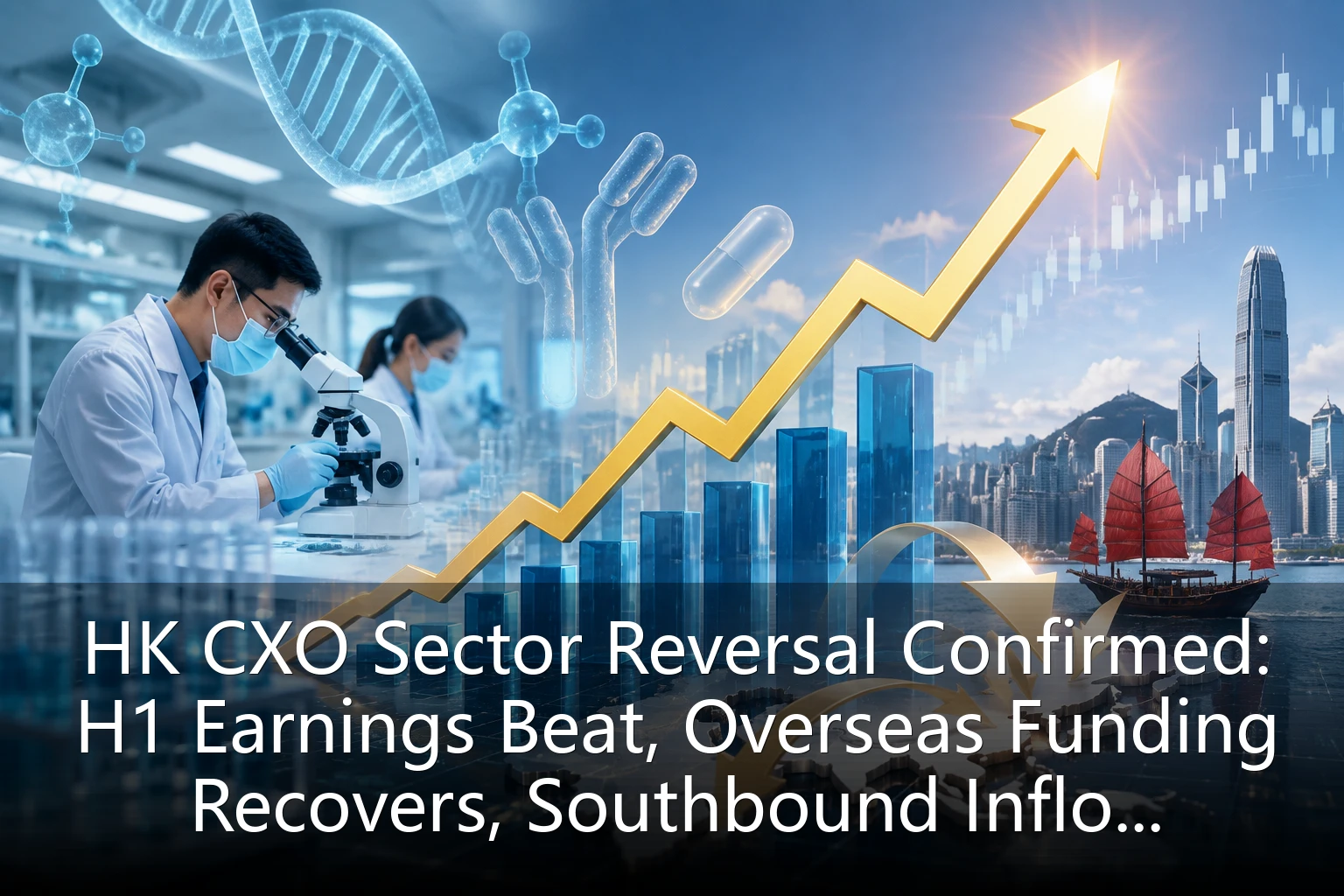
In early August 2026, the Hong Kong stock market, after experiencing previous shocks and bottoming, is quietly undergoing a shift in its main sector focus. Compared to the previously strong high-dividend assets and tech hardware sectors catalyzed by AI computing power, the long-dormant biopharma sector, especially the pharmaceutical outsourcing (CXO) track, is recently sending strong reversal signals. As a highly elastic and representative sub-sector in the HK market, the movement of the CXO sector not only affects the Hang Seng Index but also becomes a new focal point for the game between southbound capital and foreign capital.
H1 Earnings Beat Expectations, CXO Leaders' Fundamentals Hit an Inflection Point
Entering August, the H1 earnings disclosure window for HK-listed companies officially opened. Among many industries, the performance of the pharmaceutical outsourcing (CXO) sector is undoubtedly the most surprising to the market. Leading CXO companies, represented by WuXi AppTec and WuXi Biologics, have delivered H1 report cards far exceeding market expectations. According to preliminary industry data, the YoY growth rate of new orders for multiple leading companies in the first half of 2026 generally rebounded to over 20%, and the total outstanding unfulfilled orders for some companies even hit record highs.
This data effectively breaks the previous pessimistic expectations of "order loss" and "declining prosperity" for the CXO industry. Looking back over the past two years, suppressed by the global high-interest-rate environment, R&D investments and financing scales of innovative pharma companies shrank significantly, and the CXO industry experienced a brutal de-valuation process. However, the H1 2026 performance indicates that the worst moment for the industry has passed. Relying on the integrated CRDMO (Contract Research, Development, and Manufacturing) business model, leading companies not only successfully retained existing customers but also gained considerable new shares in emerging businesses such as peptide drugs and ADC (Antibody-Drug Conjugate) outsourcing.
From the financial report details, the gross profit margin of these CXO leaders in Q2 2026 showed signs of sequential improvement. This is mainly due to the increase in capacity utilization and the higher proportion of high-margin businesses. After surviving the industry winter, companies generally adopted strict cost reduction and efficiency enhancement measures. Now, with the recovery of orders, operating leverage begins to show, and the repair speed on the profit side is even faster than on the revenue side, laying a solid fundamental foundation for the sector's valuation repair.
Overseas Biopharma Financing Recovers, Industry Demand Side Sees Spring
The CXO industry is essentially the "water seller" of the innovative drug R&D supply chain, and its prosperity highly depends on the financing environment of the global biopharma industry. Encouragingly, the investment and financing data in the global biopharma sector in Q2 2026 showed an accelerating recovery trend.
According to the latest statistics, in the first half of 2026, the YoY growth of venture capital (VC) and private equity (PE) financing amounts in the global healthcare sector exceeded 15%, with the sequential growth rate in Q2 reaching double digits. The interest rate cut cycle initiated by the Federal Reserve since the end of last year has finally transmitted to the financing side of real-world innovative pharma companies. With the decline in the US dollar risk-free interest rate, long-duration, high-risk biopharma assets have regained favor from long-term funds.
Specifically at the project level, financing for mid-to-late clinical and commercialization stage projects is particularly active. This means that when innovative pharma companies advance their pipelines to key nodes, the risk of capital chain rupture is greatly reduced, thereby enabling them to outsource more R&D and production processes to professional CXO companies. In addition, recent M&A activities by overseas large pharma companies (MNCs) have also significantly warmed up. To supplement their pipelines, MNCs tend to look for high-quality targets in early-stage pipelines, which not only provides exit channels for Biotech but also indirectly drives the demand for early R&D outsourcing services.
Under this macro background, the rise of the HK CXO sector is not an isolated event, but resonates with the recovery of the global biopharma cycle. The market gradually realizes that while previous concerns about geopolitical factors suppressed valuations sentimentally, they did not substantively block the deep participation of Chinese CXO companies in the global supply chain. Relying on the engineer dividend, a perfect supply chain system, and efficient project delivery capabilities, Chinese CXO companies still possess irreplaceable comparative advantages in the global market.
Southbound Capital Daily Inflow Exceeds HK$4 Billion, Mainland Pricing Power Highlights
Against the backdrop of fundamental and macro cycle resonance, capital's sense of smell is the most acute. Since August, intraday trading data in the HK market shows that southbound capital is buying HK pharma stocks with unprecedented intensity.
In the most recent trading day, the net purchase of the HK biopharma sector by southbound capital broke the HK$4 billion mark, setting a new high for single-day net purchases in this sector over the past half-year. Among them, WuXi series stocks, Pharmaron, and Tigermed have become targets chased by funds. From the changes in the Dragon-Tiger List and the shareholding ratios of Shanghai-Hong Kong and Shenzhen-Hong Kong Stock Connect, mainland capital is accelerating the accumulation of these undervalued core assets through the Stock Connect channels.
The massive buying by mainland capital reflects two deep-seated market logics. First, is the urgency of valuation repair. Even after the recent rebound, the overall price-to-earnings ratio (PE) of the HK CXO sector remains at the historical bottom. Compared to similar pharma companies in the A-share market, the AH premium ratio of HK CXOs has significantly widened, and the valuation depression effect is extremely obvious. For southbound capital focusing on the margin of safety, this is a highly attractive left-side layout opportunity.
Second, is the mainland capital's fight for HK pricing power. For a long time, the HK market has been dominated by overseas foreign capital, making it extremely sensitive to Federal Reserve policies and geopolitical events, leading to frequent irrational valuation cuts in the HK CXO sector. With the continuous rise in the holding ratio of southbound capital, mainland capital is gradually changing the market ecology of HK. When overseas funds sell due to macro noise, mainland capital dares to take over, making the bottom support of HK increasingly solid, and the sector's volatility is also expected to converge accordingly.
HSI Technicals Stabilize, Sector Rotation Brings New Trading Opportunities
From the broader market perspective, the Hang Seng Index's trend in early August also showed a stabilizing and improving trend. Driven by the CXO pharma sector, coupled with the cooperation of internet tech and consumer sectors, the HSI successfully built a solid support platform near the 21,500-point mark.
Technical analysis shows that the HSI has broken through the upper track of the previous descending channel, and the short-term moving average system has begun a bullish alignment. The MACD indicator formed a golden cross near the zero axis, and the red bars are gradually enlarging, indicating that bullish momentum is accumulating. As a heavyweight sector with a significant dragging and pulling effect on the index, the stabilization and rebound of pharma stocks not only sealed the downside space of the broader market but also injected bullish sentiment into the market.
For investors, the sector rotation characteristics of the current HK market are very obvious. The previously overbought high-dividend sector recently entered a shrinking adjustment period, while growth stock sectors represented by CXO have taken over the spilled funds, starting a valuation repair rally. This healthy sector rotation helps extend the overall rebound time window of the HK market.
Institutional Views: Right-side Signal Confirmed, Focus on Three Types of Niche Leaders
Regarding the latest trend of the HK CXO sector, Wall Street and mainstream domestic brokerage institutions have released positive research views. Multiple institutions upgraded the rating of the pharmaceutical outsourcing industry to "Overweight" or "Buy" in recent research reports.
Institutions generally believe that the current time point is an excellent window to layout the HK CXO sector. On one hand, earnings beats and order recoveries constitute a solid right-side logic; on the other hand, valuations are still low, with broad room for upward repair. In terms of specific operational strategies, institutions suggest investors focus on the following three types of niche leaders:
- Full-industry Chain Integrated Leaders: These companies have full-chain service capabilities from drug discovery to commercial manufacturing, extremely strong anti-risk capabilities, and a moat in capacity utilization and scale effects, making them the preferred targets for both foreign and mainland capital allocations.
- Specialized and Sophisticated Enterprises in Niche Tracks: Such as CDMO companies focusing on cutting-edge hot areas like peptides, oligonucleotides, and ADCs. These sub-tracks are in an explosive period with good competitive landscapes, and companies are expected to enjoy higher valuation premiums.
- Leading Clinical CRO Companies: As new drug R&D pipelines gradually advance to mid-to-late clinical stages, the demand for clinical CROs will see a concentrated release. Clinical CRO leaders with global multi-center clinical trial execution capabilities will usher in a dual repair of performance and valuation.
In summary, the HK market in August 2026 is brewing a fundamentally driven valuation repair rally. The strong rise of the pharmaceutical outsourcing CXO sector is not only an epitome of the industry cycle bottoming out and rebounding but also a true portrayal of global capital seeking high-growth assets again under the interest rate cut cycle. With the continuous escort of southbound capital, the HK market is expected to completely step out of the previous haze and welcome a structural bull market rally. Investors should closely monitor the marginal changes in subsequent policies and overseas financing data, and seize this highly elastic trading opportunity.