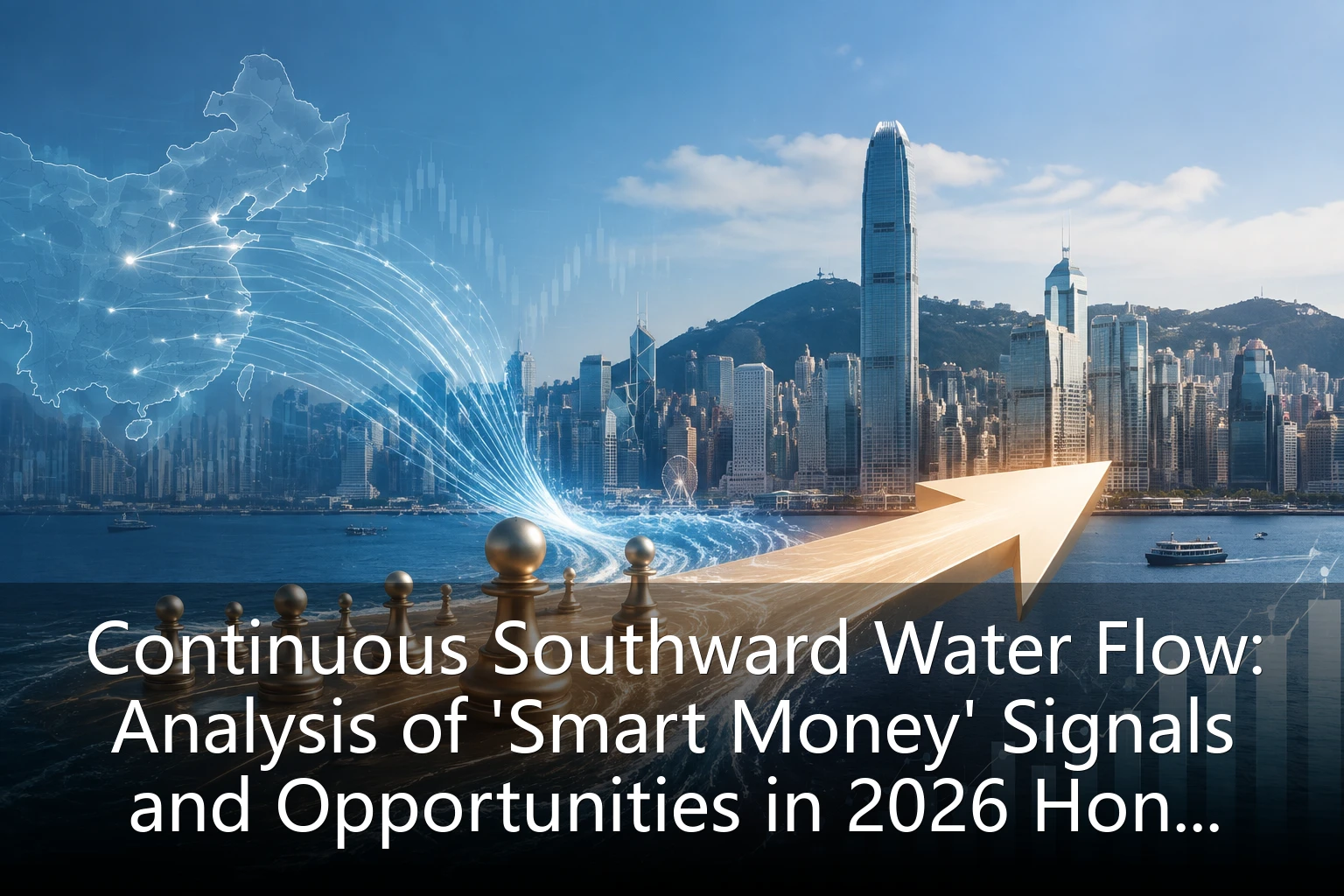
Continuous Southward Water Flow: Analysis of 'Smart Money' Signals and Opportunities in 2026 Hong Kong Stock Investment
\n\nIn August 2026, with changes in the global capital market landscape and increasing demand for diversified allocation from mainland investors, the Hong Kong stock market has once again become a focus of attention for "smart money." Data shows that southbound funds (southward water flow) have maintained a net buying position for five consecutive weeks, with a single-week net inflow exceeding 10 billion Hong Kong dollars. This phenomenon not only reflects the confidence of mainland investors in the Hong Kong stock market but also provides an important reference for global capital to reassess the value of Hong Kong stocks.
\n\nLatest Trends and Deep-Driving Factors of Southward Water Flow
\n\nAs of August 10, 2026, southbound funds have cumulatively net purchased more than 80 billion Hong Kong dollars worth of Hong Kong stocks through the Hong Kong Stock Connect channel, setting a new high for the year. This capital flow is the result of multiple factors working together. Firstly, the Hong Kong stock market has obvious valuation advantages, with the Hang Seng Index's P/E ratio less than 10 times, which is at a relatively low level compared to major global markets, providing a safety margin for value investors.
\n\nSecondly, the dual-currency counter mechanism recently launched by the Hong Kong Stock Exchange has further enhanced the liquidity convenience of the Hong Kong stock market. The proportion of RMB-denominated stock transactions has increased to 30%, reducing the exchange rate risk and transaction costs for mainland investors. This institutional innovation has significantly enhanced the attractiveness of Hong Kong stocks to mainland investors.
\n\nThirdly, during the mid-report season, the performance of Hong Kong listed companies has shown clear differentiation. High-dividend sectors have performed steadily, and technology stocks, especially AI-related concept stocks, have achieved excess returns, providing diversified choices for investors with different risk preferences. Data shows that in the first half of 2026, the total dividend distribution in the Hong Kong stock market increased by 15% year-on-year, with dividend rates generally higher than in the A-share market.
\n\nCore Investment Advantages of the Hong Kong Stock Market
\n\nAs an important bridge connecting mainland China with international capital, the Hong Kong stock market has multiple irreplaceable investment values. Firstly, the Hong Kong stock market has a more complete investor structure and a more mature regulatory system, with higher market pricing efficiency, allowing quality assets to receive reasonable valuations.
\n\nSecondly, the Hong Kong stock market provides a rich variety of investment targets, covering multiple industries such as technology, finance, consumption, and medicine. Many new economy enterprises choose to list in Hong Kong, providing investors with opportunities to share in the dividends of China's economic development. As of August 2026, there are more than 2,500 listed companies in the Hong Kong stock market, with a total market value exceeding 30 trillion Hong Kong dollars.
\n\nThirdly, the Hong Kong stock trading mechanism is flexible, supporting T+0 trading, no price limit restrictions, and other features, providing more operational space for short-term investors. At the same time, the continuous improvement of the Hong Kong Stock Connect mechanism has continuously lowered the threshold for mainland investors to participate in Hong Kong stock investment. Currently, the asset threshold for individual investors has been reduced to 300,000 RMB.
\n\nInvestment Logic Behind Southward Water Flow
\n\nThe continuous flow of mainland capital to Hong Kong stocks is not accidental but based on rational judgments about market fundamentals and investment value. From an asset allocation perspective, the correlation between Hong Kong stocks and A-shares and US stocks is relatively low, serving to diversify investment risks. Against the backdrop of increasing global economic uncertainty, the value of low-correlation asset allocation is highlighted.
\n\nIn terms of industry distribution, southbound funds mainly flow into high-dividend blue-chip stocks, technology leaders, and scarce consumer brands. These targets have stable cash flows, good growth potential, and high safety margins, meeting the current market demand for certainty. Data shows that since 2026, the allocation ratio of southbound funds to Hang Seng Index components has exceeded 60%, and the allocation ratio to the technology sector has increased to 25%.
\n\nIn terms of investment strategy, southward water flow shows the characteristic of "combining long-term and short-term." There are both long-term allocations to value-type assets and short-term grasps of growth opportunities. This diversified investment strategy allows southbound funds to obtain relatively stable returns in different market environments.
\n\nRisks and Responses in Hong Kong Stock Investment
\n\nAlthough the Hong Kong stock market has many advantages, investors still need to be vigilant about related risks. Firstly, the Hong Kong stock market has high volatility and is significantly affected by international political and economic situations. Investors need to do a good job in risk management and position control. Since 2026, the maximum amplitude of the Hang Seng Index has exceeded 20%, much higher than the A-share market.
\n\nSecondly, there are differences between Hong Kong stock trading rules and A-share rules, such as T+0 trading, no price limit restrictions, and different trading times. New investors need to fully understand and adapt to these differences. At the same time, Hong Kong stock trading costs are relatively high, including stamp duty, transaction commissions, etc. Investors need to comprehensively consider cost factors.
\n\nThirdly, the Hong Kong stock market is greatly affected by international capital flows, especially during changes in the Federal Reserve's monetary policy, market volatility may intensify. Investors need to closely follow international macroeconomic situations and monetary policy trends, and adjust investment strategies in a timely manner.
\n\nPractical Guide for Newcomers to Participate in Hong Kong Stock Investment
\n\nFor investors who are new to the Hong Kong stock market, it is recommended to adopt a gradual strategy. Firstly, opening a Hong Kong Stock Connect account is currently the most convenient way for mainland investors to participate in Hong Kong stock investment, which can be opened through mainland securities firms without the need to directly open an account in Hong Kong.
\n\nSecondly, it is recommended that investors start with familiar fundamental analysis, focusing on core elements such as the company's financial condition, industry position, and management capabilities. The Hong Kong stock market has relatively standardized information disclosure, and investors can obtain rich information through company announcements, research reports, and other channels.
\n\nThirdly, reasonably control the investment ratio to avoid excessive concentration in a single market or industry. According to individual risk tolerance, Hong Kong stock assets can be allocated between 10%-30% of total assets to achieve a balance between risk diversification and return optimization.
\n\nOutlook for Hong Kong Stock Investment in the Second Half of 2026
\n\nLooking forward to the second half of 2026, the Hong Kong stock market is expected to maintain structural opportunities supported by multiple favorable factors. Firstly, the rising expectation of Federal Reserve interest rate cuts will reduce global capital costs, which is conducive to the valuation recovery of Hong Kong stocks. Secondly, the continuous recovery of mainland China's economy will provide fundamental support for the Hong Kong stock market.
\n\nFrom an industry allocation perspective, investment opportunities in high-dividend sectors, especially AI-related concepts in technology, new energy, and other fields are worth paying attention to. At the same time, with the further optimization of the Hong Kong Stock Connect mechanism, the convenience for mainland investors to participate in Hong Kong stock investment will continue to improve, and market liquidity is expected to further improve.
\n\nOverall, the continuous inflow of southward water flow not only reflects the confidence of mainland investors in the Hong Kong stock market but also provides an important reference for global capital to reassess the value of Hong Kong stocks. Against the backdrop of the current adjustment of the global economic landscape and the transformation and upgrading of China's economy, the Hong Kong stock market, as an important bridge connecting mainland China with international capital, will further enhance its investment value and strategic significance. For investors seeking diversified asset allocation, the Hong Kong stock market undoubtedly provides rare investment opportunities.
\n\nWhile grasping the investment opportunities in Hong Kong stocks, investors also need to fully understand related risks, make long-term investment plans, and avoid blindly chasing gains and selling losses. Through rational analysis and scientific allocation, the Hong Kong stock market is expected to become an important part of investors' asset portfolios, providing continuous momentum for wealth growth.