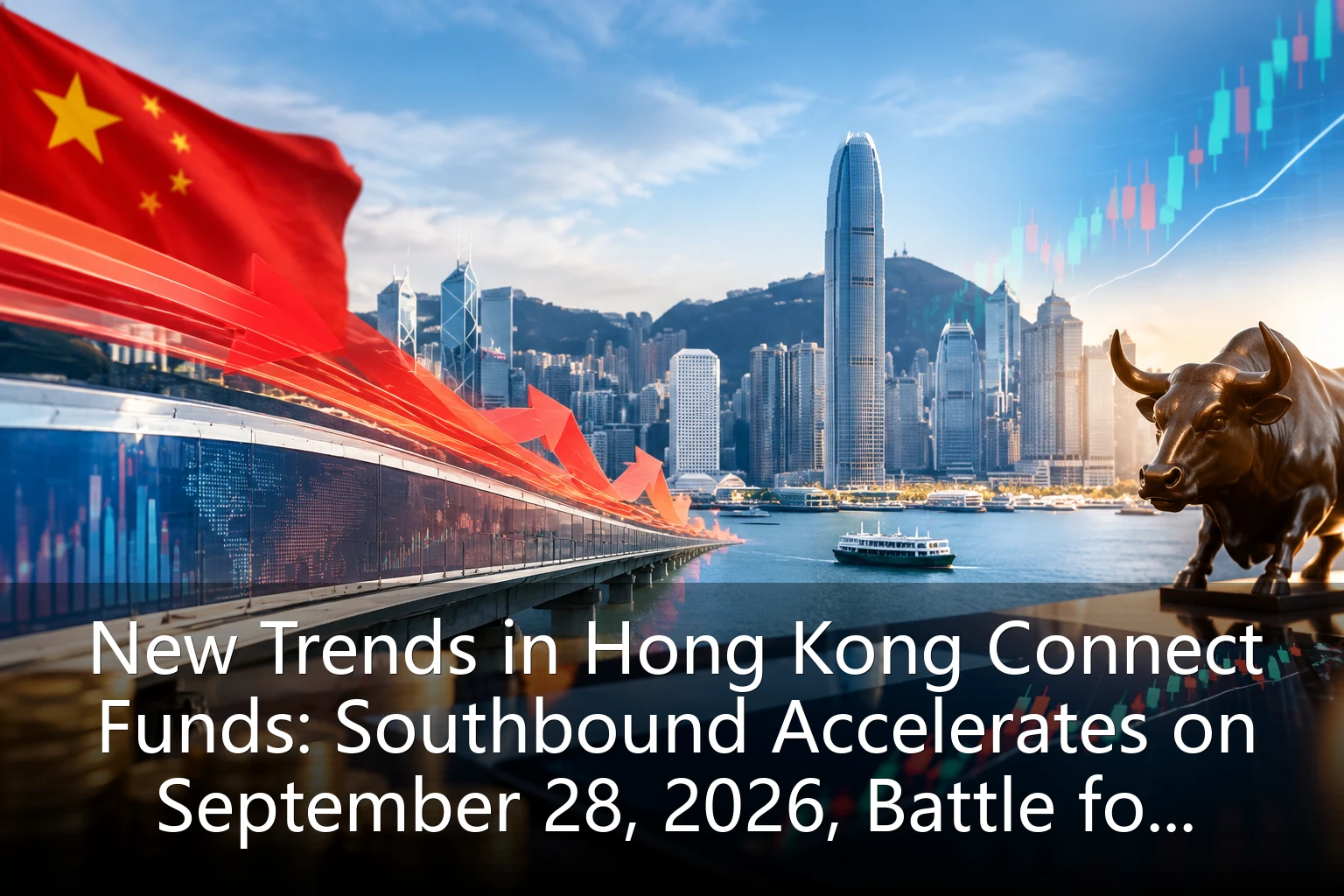
New Trends in Hong Kong Connect Funds: Southbound Accelerates on September 28, 2026, Battle for 22,000 Points in Hang Seng Index Enters Critical Stage
\nOn September 28, 2026, the Hong Kong market faced a critical trading day. As the Hang Seng Index engaged in a tug-of-war around the 22,000-point level, Hong Kong Connect fund flows showed significant changes, with southbound investment accelerating, injecting new vitality and uncertainty into the market. This article will conduct an in-depth analysis of the latest Hong Kong Connect fund dynamics, interpret the underlying market logic, and provide investors with a comprehensive perspective on the current Hong Kong market.
\n\nI. Latest Dynamics of Hong Kong Connect Fund Flows
\nAccording to the latest data, on September 28, 2026, Hong Kong Connect funds showed a net inflow trend, with a total net inflow of 6.87 billion Hong Kong dollars for the day, an increase of about 23% compared to the previous trading day. Among them, Hong Kong Connect (Shanghai) had a net inflow of 3.23 billion Hong Kong dollars, and Hong Kong Connect (Shenzhen) had a net inflow of 3.64 billion Hong Kong dollars, with Shenzhen-Hong Kong Connect funds showing more active performance.
\n\nIn terms of fund flow structure, today's Hong Kong Connect funds showed clear industry preference differentiation. Financial, technology, and energy sectors received fund favor, with net inflows of 1.82 billion, 1.56 billion, and 1.28 billion Hong Kong dollars respectively. Meanwhile, the consumer sector saw a small net outflow, indicating a shift in investors' risk appetite.
\n\nNotably, among the top 10 most active Hong Kong Connect stocks, heavyweight stocks such as Tencent Holdings, Ping An Insurance, China Construction Bank, Meituan, and Alibaba all received net purchases, contributing about 35% of the total Hong Kong Connect trading volume for the day, showing continued attention from mainland capital to Hong Kong's core assets.
\n\nII. Market Logic Behind Accelerated Southbound Investment
\nAnalysts point out that the accelerated southbound investment on September 28 was driven by multiple factors. First, as the Federal Reserve's interest rate hike cycle approaches its end, the global liquidity environment is becoming more accommodative, and international capital is beginning to reassess asset allocation, with Hong Kong's valuation attractiveness increasing as a valuation low point.
\n\nSecond, the mainland economy shows a good recovery trend with improved corporate profit expectations, providing fundamental support for the Hong Kong market. Especially with the Hong Kong mid-report season approaching, investors are positioning in advance in sectors expected to exceed earnings expectations.
\n\nThird, with the implementation of the new Hong Kong Connect rules for a full month, the optimized trading mechanism has lowered investment thresholds and increased mainland investors' participation in Hong Kong stocks. Data shows that after the implementation of the new Hong Kong Connect rules, the average daily trading volume increased by about 18%, significantly improving market activity.
\n\nIn addition, the easing of geopolitical risks and rising expectations for improvement in China-US economic and trade relations have also prompted international capital to flow back to the Hong Kong market. According to statistics, since September, the scale of foreign capital returning to Hong Kong has exceeded 20 billion Hong Kong dollars, forming a pattern where domestic and foreign capital jointly drive the market.
\n\nIII. Battle for 22,000 Points in Hang Seng Index Enters Critical Stage
\nAs of the close on September 28, the Hang Seng Index closed at 21,986.75 points, up 0.68%, with a trading volume of 98.76 billion Hong Kong dollars. The Hang Seng Index is engaged in a fierce battle around the 22,000-point level, with both bulls and bears in a stalemate, showing cautious yet optimistic market sentiment.
\n\nTechnical analysis shows that the Hang Seng Index is currently at a critical position. Looking at the daily K-line chart, the index has formed a dense trading area around the 22,000-point level, where bulls and bears are engaged in a tug-of-war. In the short term, if it can effectively break through the 22,000-point level, it may open up upward space; conversely, if it encounters resistance and falls back at this position, it may enter a consolidation phase.
\n\nMarket analysts point out that the 22,000-point level in the Hang Seng Index is not only an important psychological barrier but also a key technical resistance level. There is a large concentration of previously trapped positions near this level, making breakthroughs difficult. However, from a fundamental perspective, as Hong Kong corporate profit expectations improve and valuation attractiveness increases, breaking through the 22,000-point level is just a matter of time.
\n\nIV. Sector Rotation and Investment Opportunities Behind Fund Flows
\nFrom a sector rotation perspective, the Hong Kong market has shown obvious structural characteristics recently. Fund flow data shows that technology, financial, and energy sectors have become key focuses of funds, while defensive sectors such as consumer and utilities have been relatively neglected.
\n\nIn the technology sector, sub-sectors such as artificial intelligence, cloud computing, and semiconductors have shown outstanding performance. Benefiting from the global technology industry recovery and domestic digital economy policy support, related leading stocks have received continuous fund favor. Internet giants like Tencent Holdings and Alibaba have shown strong stock price performance recently, driving the entire technology sector higher.
\n\nIn the financial sector, banking and insurance stocks have received fund favor. Analysts point out that with the mainland economic recovery and improved interest rate environment, the asset quality and profitability of bank stocks are expected to improve, while insurance stocks benefit from the expansion of interest rate spreads in an upward interest rate cycle.
\n\nIn the energy sector, both traditional energy and new energy companies have received fund attention supported by global energy structure adjustment and new energy policies. Especially oil and gas stocks, benefiting from the stabilization and recovery of international oil prices, have sufficient valuation recovery momentum.
\n\nIn contrast, the consumer sector has shown relatively weak performance recently. Data shows that the allocation ratio of Hong Kong Connect funds to consumer stocks decreased by about 3 percentage points compared to the previous month. The main reason is that the consumption recovery process is below expectations, and investors' confidence in the consumer sector has weakened.
\n\nV. Risk Warnings and Investment Strategy Recommendations
\nAlthough the Hong Kong market has shown positive performance recently, investors should still be alert to potential risks. First, the global economic recovery process still has uncertainties, especially the relatively large inflation pressure in Europe and the United States, which may limit the space for monetary policy easing, affecting the liquidity environment of the Hong Kong market.
\n\nSecond, although geopolitical risks have eased, uncertainties still exist, which may cause periodic disturbances to market sentiment. In addition, although Hong Kong market valuations have a discount compared to A-shares, valuations in some hot sectors are not cheap, and investors should pay attention to valuation correction risks.
\n\nIn view of the current market environment, we provide the following strategic recommendations for investors:
\n\n- \n
- Grasp structural opportunities, focusing on quality targets in the three major sectors of technology, finance, and energy, especially those leading stocks with strong earnings growth certainty and reasonable valuations. \n
- Adopt a balanced allocation strategy, maintaining appropriate balance between offensive and defensive sectors to cope with possible market fluctuations. \n
- Pay attention to changes in Hong Kong Connect fund flows, using southbound investment as an important reference indicator to follow the "smart money" layout. \n
- Control position sizes, avoid excessive chasing of highs, and appropriately reduce positions to lock in gains, especially for stocks that have risen significantly. \n
- Utilize the trading mechanism optimization brought by the new Hong Kong Connect rules to appropriately participate in Hong Kong market derivative trading to hedge risks. \n
VI. Future Outlook and Market Expectations
\nLooking ahead, most institutions maintain a cautiously optimistic attitude toward the Hong Kong market. It is expected that with the gradual global economic recovery and improved corporate profits, the Hong Kong market is likely to continue its upward trend with fluctuations, and the possibility of the Hang Seng Index breaking through the 22,000-point level is relatively high.
\n\nIn terms of fund flows, southbound investment will continue to be an important supporting force for the Hong Kong market. As mainland investors' understanding of and participation in Hong Kong stocks deepen, the scale of Hong Kong Connect funds is expected to continue growing, providing liquidity support for the market.
\n\nIn terms of industry allocation, technology, financial, and energy sectors are expected to continue to lead, while defensive sectors such as consumer and utilities may receive fund favor during market adjustment phases. In addition, emerging industries benefiting from policy support, such as new energy and high-end manufacturing, are also worth attention.
\n\nOverall, the Hong Kong Connect fund dynamics on September 28, 2026, show that southbound investment is accelerating, and the market is competing for the 22,000-point level in the Hang Seng Index. Investors should closely follow changes in fund flows, grasp structural opportunities, while being alert to potential risks, adopt a balanced allocation strategy, and find investment opportunities in fluctuations.
\n\nWith changes in the global economic landscape and China's economic transformation and upgrading, the Hong Kong market, as an important window for China's capital market opening, will continue to attract global capital attention. For investors, in-depth understanding of Hong Kong Connect fund dynamics and grasping the market pulse will be the key to obtaining excess returns.