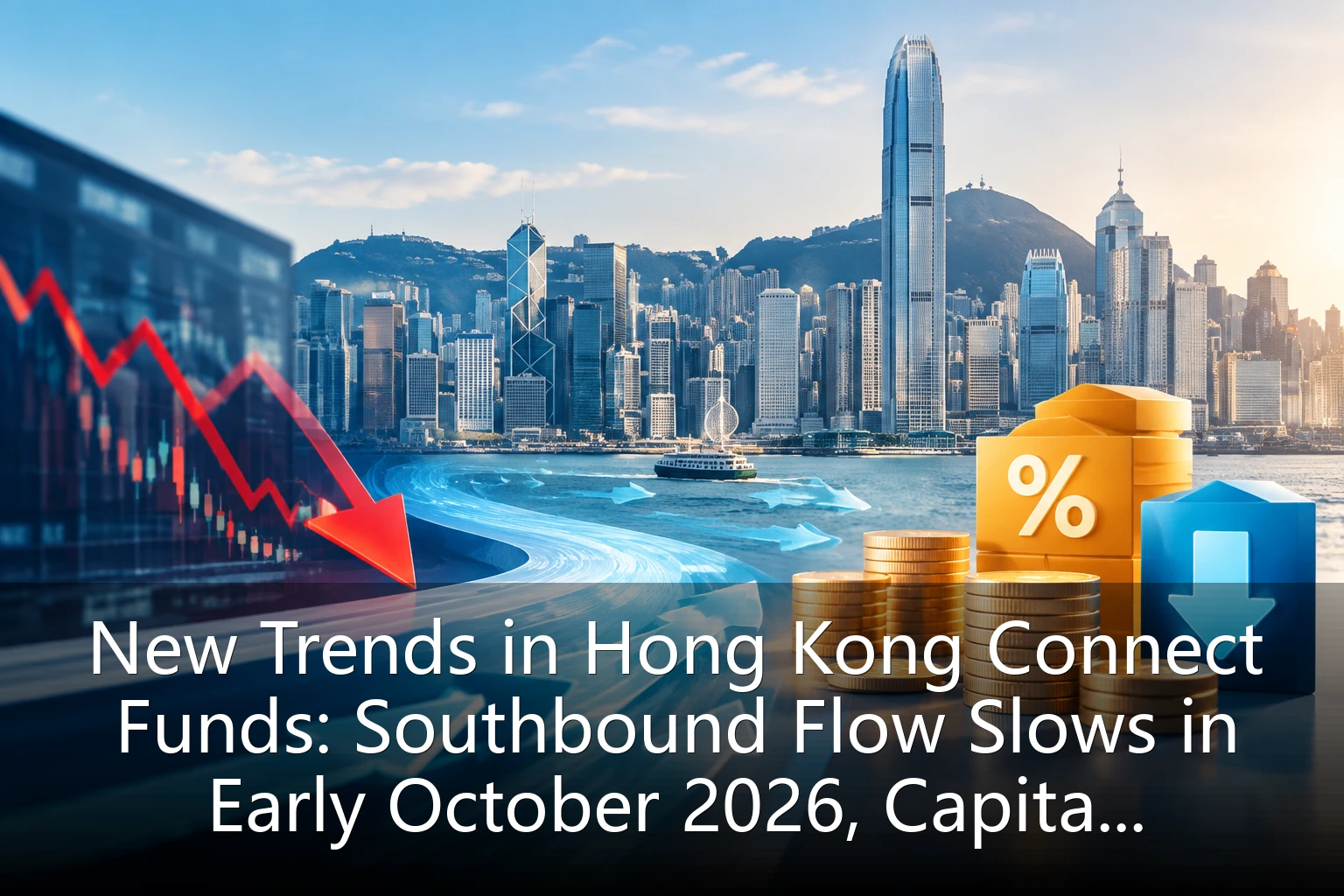
New Trends in Hong Kong Connect Funds: Southbound Flow Slows in Early October 2026, Capital Allocation Shifts to High-Dividend and Low-Valuation Sectors
\nThe Hong Kong market in early October 2026 presented a capital flow landscape markedly different from late September. Data shows that while Hong Kong Connect maintained an overall net inflow, the speed of southbound capital inflows has significantly slowed, with capital allocation strategies shifting from the comprehensive technology and energy sector positioning at the end of September to a more balanced allocation of high-dividend and low-valuation cyclical stocks. This change reflects mainland investors' reassessment of the Hong Kong market's valuation center and defensive allocation needs amid global economic uncertainties.
\n\nSouthbound Flow Slows, Capital Inflow Structure Changes
\nAccording to the latest data, in the first three trading days of early October 2026, Hong Kong Connect had a net inflow of approximately HK$8.5 billion, a significant decrease from the daily net inflow of over HK$12 billion in late September. This change is not accidental but rather the result of mainland investors' reassessment of Hong Kong market valuation levels. By the end of September, as the Hang Seng Index approached the 22,000-point mark, market valuations had gradually recovered, with some high-growth sectors being overvalued, naturally slowing the pace of capital inflows.
\n\nLooking at the capital flow structure, southbound capital allocation in early October showed a clear "defensive shift" characteristic. Traditional high-dividend sectors such as utilities, telecommunications services, and banking received favor from investors, while the technology sector, which performed prominently in late September, showed signs of capital outflows. This change reflects mainland investors' increased preference for defensive assets amid rising global economic uncertainties.
\n\nHigh-Dividend Sectors Become Safe Havens for Capital
\nIn the Hong Kong market in early October, high-dividend sectors performed exceptionally well. Data shows that the Hang Seng High Dividend Index rose 2.3% cumulatively in the first three trading days, outperforming the overall Hang Seng Index. Among them, high-dividend stocks such as China Mobile, CNOOC, and CLP Holdings received continuous southbound capital increases.
\n\nThe strength of high-dividend sectors is supported by three main factors: First, the increasing expectation of monetary policy shifts in major global economies and the approaching interest rate cut cycle have enhanced the relative attractiveness of high-dividend assets; Second, increasing geopolitical risks and market volatility have highlighted the allocation value of high-dividend assets as "defensive assets"; Finally, valuations of Hong Kong's high-dividend sectors remain relatively low, offering higher safety margins and attractiveness.
\n\nFrom an industry perspective, traditional defensive sectors such as utilities, telecommunications services, and energy have become key allocation targets for southbound capital. These industries not only have stable cash flows and high dividend yields but also show strong risk resistance during economic downturns, meeting allocation needs in the current market environment.
\n\nLow-Valuation Cyclical Stocks Receive Capital Favor
\nIn addition to high-dividend sectors, low-valuation cyclical stocks also became key areas for southbound capital allocation in early October. Data shows that low-valuation cyclical sectors such as materials, industrials, and real estate received net capital inflows, with some individual stocks like PetroChina, China Shenhua, and China Resources Land receiving continuous southbound capital increases.
\n\nThe strength of low-valuation cyclical stocks is driven by three main factors: First, these sectors' valuations are at historical lows, offering higher safety margins; Second, with strengthening expectations of Chinese economic stabilization, profit recovery expectations for cyclical sectors have improved; Finally, after comprehensive allocation to technology and energy sectors, southbound capital has begun to shift to valuation lows, seeking investment targets with greater safety margins.
\n\nLooking at individual stock performance, the rise of low-valuation cyclical stocks is not simply a valuation recovery but is accompanied by fundamental improvements. For example, some material companies have benefited from deepening supply-side structural reforms and increased industry concentration, with continuously improving profitability; some real estate companies have benefited from policy support and improved financing environments, easing operational pressures.
\n\nTechnology Sector Capital Outflows, But Structural Opportunities Remain
\nDifferent from the comprehensive inflows in late September, southbound capital to the technology sector showed an overall outflow trend in early October. Data shows that the Hang Seng Tech Index fell 1.2% cumulatively in the first three trading days, underperforming the overall Hang Seng Index. Among them, some highly valued internet platform companies such as Tencent Holdings and Alibaba showed capital outflows.
\n\nTechnology sector capital outflows are mainly affected by three factors: First, after the September rally, some tech stocks' valuations have approached historical highs, reducing valuation attractiveness; Second, global tech stocks face valuation adjustment pressure, with Hong Kong tech stocks affected by this linkage; Finally, mainland investors, after comprehensive allocation to the technology sector, have begun profit-taking and position adjustments.
\n\nDespite overall capital outflows from the technology sector, structural opportunities still exist. Sub-sectors such as artificial intelligence, cloud computing, and semiconductors continue to receive sustained attention from southbound capital. For example, some AI concept stocks such as SenseTime and Semiconductor Manufacturing International Corporation received southbound capital increases, reflecting investors' recognition of structural opportunities in the technology sector.
\n\nMarket Logic Behind Hong Kong Connect Fund Flow Changes
\nThe changes in Hong Kong Connect fund flows in early October reflect mainland investors' deepening understanding of the Hong Kong market and adjustments in investment strategies. From comprehensive allocation at the end of September to defensive allocation in early October, this change is driven by multiple market logics.
\n\nFirst, changes in the global macroeconomic environment form the basis for capital flow changes. As inflationary pressures ease in major global economies and expectations of monetary policy shifts increase, the relative attractiveness of high-dividend assets has improved. Meanwhile, increasing geopolitical risks and market volatility have risen demand for defensive asset allocation.
\n\nSecond, changes in the Hong Kong market's valuation structure are also an important reason for capital flow changes. After the September rally, Hong Kong market valuations have gradually recovered, with some high-growth sectors being overvalued while some traditional sectors remain relatively low-valued. This valuation difference has prompted capital to flow from high-valuation sectors to low-valuation sectors.
\n>\nFinally, mainland investors' deepening understanding of the Hong Kong market is also an important factor in capital flow changes. As mainland investors' understanding of the Hong Kong market deepens, investment strategies have shifted from simple "southbound bottom-fishing" to more refined industry allocation and stock selection, with greater emphasis on valuation safety margins and dividend returns.
\n\nInvestment Strategy Recommendations: Balanced Allocation, Focus on High-Dividend and Low-Valuation Opportunities
\nBased on changes in Hong Kong Connect fund flows in early October, we offer the following strategy recommendations to investors:
\n\n- \n
- Balanced Allocation to High-Dividend and Low-Valuation Sectors: In the current market environment, we recommend investors balance their allocation between high-dividend and low-valuation cyclical stocks to obtain stable dividend income while enjoying capital gains from valuation recovery. \n\n
- Focus on Structural Opportunities in Technology Sector: Despite overall capital outflows from the technology sector, structural opportunities still exist in sub-sectors such as artificial intelligence, cloud computing, and semiconductors. We recommend investors select individual stocks focusing on reasonably valued and fundamentally strong companies. \n\n
- Monitor Hong Kong Connect Fund Flow Changes: Hong Kong Connect fund flows are an important market indicator. We recommend investors closely monitor changes in southbound capital allocation to grasp market hot spot transitions and investment opportunities. \n\n
- Emphasize Risk Control: Amid increasing global economic uncertainties, we recommend investors emphasize risk control, appropriately reduce positions, avoid chasing highs, and maintain portfolio flexibility. \n
Outlook: Hong Kong Market Expected to Continue Structural Opportunities
\nLooking ahead, the Hong Kong market is expected to continue offering structural opportunities. First, as expectations of Chinese economic stabilization strengthen, the fundamental outlook for the Hong Kong market is expected to gradually improve; Second, with increasing expectations of monetary policy shifts in major global economies, Hong Kong's attractiveness as a valuation low will further increase; Finally, with continuous optimization of the Hong Kong Connect mechanism and smoother channels for mainland capital to flow south, the Hong Kong market will receive sustained capital support.
\n\nFrom a sector allocation perspective, high-dividend and low-valuation cyclical stocks will continue to receive capital favor, and structural opportunities in the technology sector will also persist. Investors should reasonably allocate various assets according to their risk preferences and investment objectives to grasp the structural opportunities in the Hong Kong market.
\n\nOverall, the changes in Hong Kong Connect fund flows in early October 2026 reflect the market's response strategies to changes in the economic environment. Investors should closely monitor capital flow changes, flexibly adjust investment strategies, and grasp the structural opportunities in the Hong Kong market while controlling risks.
\n