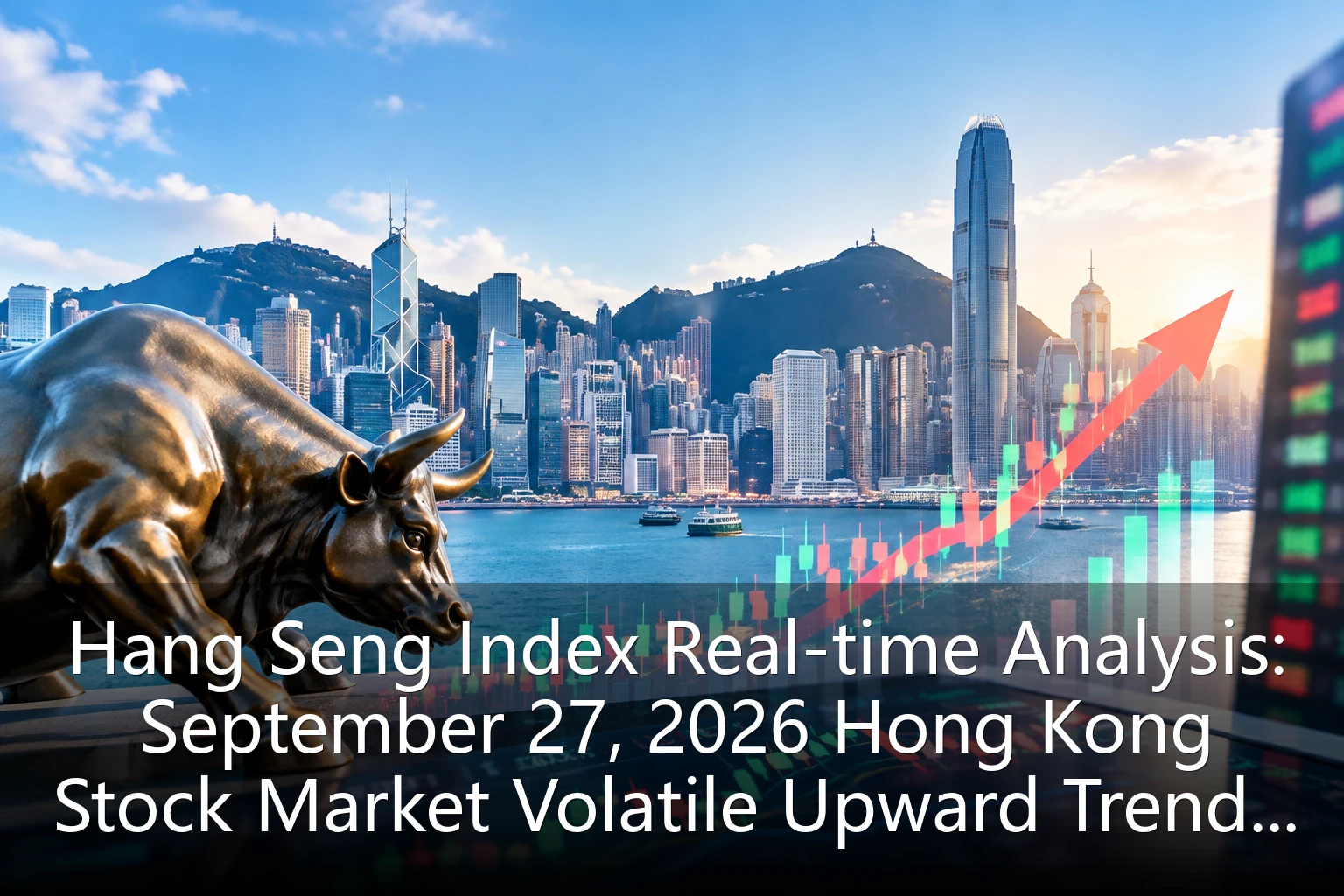
Hang Seng Index Real-time Analysis: September 27, 2026 Hong Kong Stock Market Volatile Upward Trend, Tech Stocks Lead Rebound
On September 27, 2026, the Hong Kong stock market showed a volatile upward trend. The Hang Seng Index fluctuated within a narrow range throughout the day but ultimately closed higher, with tech stocks becoming the main force leading the market rebound. With changes in the global macroeconomic environment and adjustments in regional policies, the Hong Kong stock market demonstrated unique resilience in late September, attracting the attention of domestic and international investors.
Hang Seng Index Performance and Market Overview
As of the close on September 27, 2026, the Hang Seng Index closed at 21,876.35 points, up 0.82%, with a trading volume of 125.6 billion Hong Kong dollars. Looking at the full-day trend, the index showed a "V-shaped" reversal pattern, falling in the morning due to pressure from overseas markets, but rebounding strongly in the afternoon driven by tech stocks, ultimately recovering lost ground. Market sentiment was generally cautious, but structural opportunities still exist.
The Hang Seng China Enterprises Index performed relatively weakly, closing at 7,823.45 points, up slightly by 0.35%, showing that state-owned enterprises were under certain pressure. In contrast, the Hang Seng Tech Index performed impressively, closing at 4,356.78 points, up 1.56%, becoming the main driving force behind the market rebound.
Analysis of Market Volatility Factors
Today's Hong Kong stock market volatility was mainly affected by the following factors:
- Impact of Overseas Markets: The underperformance of the US stock market overnight, with the Dow Jones Industrial Average down 0.45% and the Nasdaq Index up slightly by 0.12%, created some pressure on the Hong Kong market opening.
- Geopolitical Factors: The geopolitical tensions in the Asia-Pacific region have eased somewhat, increasing market risk appetite.
- Policy Support: The recent series of growth-stabilizing policies introduced by the mainland have been gradually implemented, providing support to the Hong Kong stock market.
- Capital Flow Changes: Continuous inflow of southbound funds has provided a bottoming effect for the Hong Kong stock market.
Tech Stocks Lead Rebound, Sector Performance Shows Differentiation
Today's Hong Kong stock market sector performance showed clear differentiation, with tech stocks becoming the market focus. Technology-related sectors such as internet platform stocks, semiconductors, and artificial intelligence performed strongly, with large tech stocks like Alibaba and Tencent Holdings rising more than 2%, driving the Hang Seng Tech Index higher.
Meanwhile, traditional financial sectors performed relatively weakly, with bank stocks generally falling slightly, mainly affected by changes in the interest rate environment. The real estate sector continued to show weakness, with most individual stocks falling, as market concerns about the real estate industry have not completely dissipated.
Notably, the new energy sector performed impressively today, with photovoltaic, wind power and other sub-sectors leading the gains. This is mainly due to the acceleration of global energy transition and the competitive advantage of China's new energy industry chain. Leading stocks such LONGi Green Energy and CATL both rose more than 3%.
Capital Flow Analysis: Continuous Southbound Fund Inflows
From a capital flow perspective, southbound funds continued to net buy Hong Kong stocks today, with a net inflow of 2.86 billion Hong Kong dollars. Among them, Hong Kong Stock Connect (Shanghai) had a net inflow of 1.53 billion Hong Kong dollars, and Hong Kong Stock Connect (Shenzhen) had a net inflow of 1.33 billion Hong Kong dollars. This indicates that mainland investors' confidence in the Hong Kong stock market remains relatively strong.
In terms of industry allocation, southbound funds mainly flowed into technology, new energy, and consumer sectors, which is relatively consistent with today's market performance. Notably, the allocation ratio of southbound funds to Hong Kong Stock Connect标的 has risen for five consecutive trading days, showing that mainland capital's willingness to allocate to Hong Kong stocks is increasing.
In terms of foreign capital, foreign capital showed a net outflow today, with a net outflow of about 1.52 billion Hong Kong dollars. Foreign capital mainly reduced holdings in financial and real estate sectors, while maintaining relatively stable allocations to the tech sector. This differentiation reflects different expectations of foreign capital for different sectors of the Hong Kong stock market.
Technical Analysis: Short-term Volatile Upward Trend for Hang Seng Index
From a technical perspective, the Hang Seng Index found support around 21,800 points today and successfully stood above the 5-day moving average, showing a clear short-term volatile upward trend. In terms of trading volume, it was slightly larger than the previous trading day, indicating increased market activity.
Looking at technical indicators, the MACD indicator shows a golden cross signal, and the RSI indicator has entered the strong zone of 50-70, indicating that short-term market momentum is increasing. However, trading volume has not completely broken through recent highs, indicating that the market needs to further confirm the sustainability of the upward trend.
In terms of support, the Hang Seng Index has strong support around 21,700 points, while the resistance level is at the 22,000 point mark. In the short term, the Hang Seng Index may continue to fluctuate and accumulate momentum in the 21,800-22,000 point range, waiting for a breakthrough direction.
Market Outlook and Investment Strategy
Looking ahead, the Hong Kong stock market may show a volatile upward trend in late September. From a macroeconomic perspective, major global economies face the dual challenges of inflationary pressure and slowing economic growth, which will put some pressure on the Hong Kong stock market. On the other hand, the steady recovery of the Chinese economy and the continuous southward flow of mainland funds will provide support for the Hong Kong stock market.
In terms of industry allocation, it is recommended to focus on the following major sectors:
- Tech Sector: Technology sub-sectors such as artificial intelligence, cloud computing, and semiconductors are expected to benefit from the acceleration of global digital transformation and have long-term growth potential.
- New Energy Sector: In the context of global carbon neutrality, the new energy industry chain will maintain high prosperity, and areas such as photovoltaics, wind power, and energy storage deserve attention.
- Consumer Sector: With the gradual recovery of the mainland consumer market, consumer leaders with brand advantages and channel advantages are expected to see a recovery in performance.
- High Dividend Sector: In a declining interest rate cycle, sectors with stable cash flow and high dividend yields will be favored by defensive funds.
In terms of investment strategy, it is recommended that investors adopt a "core-satellite" strategy, using high-dividend, low-valuation core assets as the position base, while allocating high-growth satellite assets such as technology and new energy to balance risk and return. For investors with strong risk tolerance, they can appropriately pay attention to investment opportunities under the new Hong Kong Stock Connect rules and grasp market structural opportunities.
Risk Warnings
Although the Hong Kong stock market has performed relatively stable recently, the following risk factors still need to be paid attention to:
- Increased uncertainty in the global macroeconomic environment may affect corporate profit prospects
- Geopolitical tensions may trigger market volatility
- Changes in mainland policies may impact related sectors
- Changes in Hong Kong stock market liquidity may exacerbate market volatility
Overall, on September 27, 2026, the Hong Kong stock market showed a volatile upward trend with tech stocks leading the rebound, demonstrating the market's resilience and structural opportunities. While investors should seize market opportunities, they should also remain cautious and manage risks well to cope with the complex and changing market environment.